Bonita 2023.1 and Self-Contained Applications are here!
Self-Contained Applications by Bonitasoft: the power of a BPM-based development platform coupled with the maintainability and scalability of containerized BPM applications.
Bonita 2023.1 features the first enabling technology for Self-Contained Applications: Bonita Central.
What is this major release of Bonita all about?
The revolutionary Self Contained Applications approach with Bonita 2023.1 marks a sharp departure from the approach of process-based applications deployed on a platform with shared resources. Each Self-Contained Application created with the Bonita process automation platform can be deployed into production via Docker and Kubernetes, with its own Bonita runtime and resources.
Modularity and component-based systems have already been successfully applied for many years in information systems and software development. Infrastructures are composable; we no longer buy machines but CPU, memory, disk space, bandwidth, and so on. In software development we see composability applied through containerization, an approach that is already widely used and becoming the standard for DevOps teams, as shown for example by the growing use of platforms such as Docker and Kubernetes.
The arrival of Bonitasoft’s Self-Contained Applications with Bonita 2023.1 is setting the same trend for composable BPM process-based applications. BPM technologies already fit perfectly into the approach of composable architectures. Applications themselves are also already internally made up of composable elements: processes, sub-processes, connectors, services, reusable pieces of code, business rules, and UI fragments to name a few.
With Bonita 2023, Bonitasoft is now adding containerization to the mix. Bonita’s Self-Contained Applications capability will combine the benefits of containerization approaches and technologies with the power of its BPM application platform technologies for application development. The BPM base offers wide extensibility to integrate with enterprise IS, with good auditability, traceability, and compliance; deployment of individual applications using containers offers faster delivery, portability, and easier management.
DevOps teams can deploy complex applications more easily, deliver continuously, and thus support innovation and faster time to market. Each Self-Contained App can be deployed individually, independently, and fast to deliver increased value through improvements as quickly as the business requires.
What’s in Bonita 2023.1?
Bonita 2023.1, a major release of the flagship product of Bonitasoft, offers the first technologies to support Self-Contained Applications: containerized deployment capabilities and Bonita Central, the management tool to monitor and control applications running “in the wild” without a single platform in common. With Bonita Central, DevOps can monitor the use of resources, and system admins and process owners can monitor the status of all deployed apps individually.
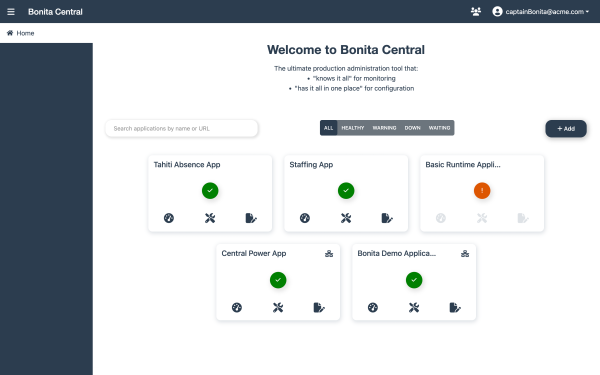
Bonita Central
Bonita Central also allows Bonita Enterprise users who are currently using multi-tenancy to switch instead to the multi-runtime capability of Bonita 2023.1, with a centralized view of their Bonita application portfolio.

There’s more in Bonita 2023.1: easier means to build accessible Bonita apps, faster user account provisioning with single sign-on, a wizard for connection to the Bonita Artifact Repository, new API documentation, and more!

Schedule a personalized demo and see how Ofelia can transform your AI infrastructure.