Home
/
Ressources
/
Blog
/
Tech trends
/
BPM and RPA - technology & strategy
Blog article

BPM and RPA - technology & strategy

Bonitasoft
July 7, 2026
Updated on
July 6, 2026
3
min read

Forrester Research has projected that the robotic process automation market, while only $250 million in 2016, will grow to $2.9 billion in 2021.

The looming question facing management in the very near future is not, "Do we need RPA in this organization?" but rather "How are we going to apply RPA in the most strategic way possible?"

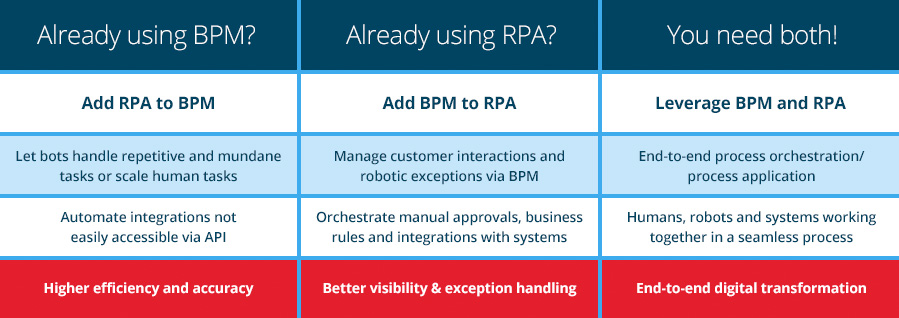
Immersed in the world of business process management, of course we tend to look first at a wholistic approach:  how can the users of business applications best benefit from RPA capabilities?

When we partnered with UiPath, a leading global provider of RPA software, we both took a good look at where RPA and BPM technologies naturally intersect in Bonita and UiPath. From a technology integration perspective, UiPath and Bonitasoft teams are finishing a native integration in which an activity in UiPath will natively launch Bonita processes, and conversely, how connectors in Bonita will call robots through the UiPath Orchestrator from any step of a process.

Stay tuned as this work will be available before the end of the year. And in the meantime, have a look at this webinar video, where we explore the intersection of BPM and RPA conceptually as we begin to dig into the technology "nuts and bolts."
Ready to orchestrate your AI operations?

Schedule a personalized demo and see how Ofelia can transform your AI infrastructure.

Obtenir une démo
Bonitasoft

Questions fréquentes
Sed ut perspiciatis unde omnis iste natus error sit voluptatem accusantium doloremque laudantium, totam rem aperiam.
Quels types de partenaires sont référencés ici ?
Des cabinets de conseil, intégrateurs systèmes et spécialistes en implémentation qui aident les organisations à déployer Ofelia et à le connecter à leurs outils et processus existants. Ils apportent le contexte, les relations et l'expertise pour transformer un déploiement en impact opérationnel réel.
Comment choisir le bon partenaire pour mon projet ?
Regardez leur focus sectoriel et leur bilan de livraison. Le bon partenaire travaille déjà dans des environnements comme le vôtre. Il a géré les contraintes de conformité, les systèmes legacy, les dynamiques internes. Pas sûr par où commencer ? Nous vous aidons à trouver le bon profil — contactez-nous et nous vous orientons.
Un partenaire peut-il m'aider à définir par où commencer ?
Oui. La plupart des partenaires mènent une phase de cadrage avant tout déploiement. Ils identifient les workflows qui créent le plus de friction et définissent où vous obtenez des résultats en premier. Vous n'avez pas besoin d'un cahier des charges. Vous avez besoin d'une conversation.
Combien de temps faut-il pour passer en production ?
Premier workflow en jours, pas en mois. Aucun projet d'infrastructure, aucun sprint IT dédié. Le process owner pilote le déploiement.
Y a-t-il une taille minimale pour travailler avec un partenaire ?
Non. Ce qui compte, c'est le défi opérationnel — pas l'effectif. Les partenaires travaillent aussi bien avec des entreprises en forte croissance qu'avec de grands groupes.