AI assistants make each person more productive. The quarter is won beyond the CRM, between teams and across systems, and that’s where agentic orchestration puts AI to work, so it finally shows in revenue.

AI for sales is now part of the daily routine. AI assistants draft follow-up emails and summarise calls, while agents research accounts before a first meeting. 87% of sales organisations use at least one form of it.¹
It made reps faster. The revenue line hasn’t noticed. At our September summit, 86% of the executives we surveyed said AI made their teams more productive. Only 10% said it had moved revenue, and 62% couldn’t measure its impact at all.*
The reason is simple. Most AI in sales today (assistants, copilots and even agents) helps individuals, while revenue depends on how a deal moves between teams and systems: from the rep to the deal desk, Legal, Finance and delivery, through tools that don’t talk to each other. That’s where AI has to work if you want to see it in the quarter.
* Ofelia Summit barometer, C-level and executives, September 2026.
¹ Survey of sales professionals by a CRM vendor, February 2026.
- 86%say AI made their teams more productive
- 10%say it moved revenue
- 62%can't measure its impact at all
The copilot ceiling: AI for sales stops at individual productivity
Ask reps what AI changed for them and the answers are concrete: notes they no longer type after a call, a proposal that starts from a draft instead of a blank page, a CRM update done in one sentence. Each gain is small, and each one is real.
Added up across a team, those minutes look like a lot. A former Chief Commercial Officer we spoke with, who ran around 80 salespeople at a financial services firm, judged every sales tool with one calculation: save each of fifty salespeople one hour a week, and you have gained the equivalent of one more seller.
That is also where the gains stop. A saved hour belongs to one person and spreads across her day. Some of it goes to leads, most of it to the next email, and almost none of it shows up as a line in the P&L. McKinsey found in 2025 that nearly eight in ten companies use generative AI, and about as many report no significant impact on their bottom line. It points at horizontal copilots in particular, whose gains are spread thin across many people and hard to measure.
Gartner expects the gap to widen before it narrows. It predicts that by 2028 AI agents will outnumber sellers ten to one, and that fewer than 40% of sellers will say those agents made them more productive.
This is the copilot ceiling. AI for sales makes each person more productive, and it stops there, because the number a CRO is held to doesn’t only depend on how fast one person works. It depends on what happens once the deal leaves the rep’s desk, and no assistant follows it there.
Revenue is decided beyond the CRM, in the coordination between teams and systems
The real bottleneck in sales was never speed. It was coordination.
Take a strategic deal at Commit, three weeks before the end of the quarter. To sign, it needs four answers. Engineering has to confirm the technical fit. Legal has to accept a redline. Finance has to approve a pricing exception. And IT security has to complete the buyer’s security questionnaire, eighty questions long. None of these four people work in the CRM, and none of them has this deal at the top of their list.
So the rep chases: four threads in Slack, a couple of emails, a reminder slipped into a meeting. Engineering answers on day two. Legal answers on day six, after a nudge. Finance asks for more context, and the questionnaire waits for an analyst who is out until Monday.
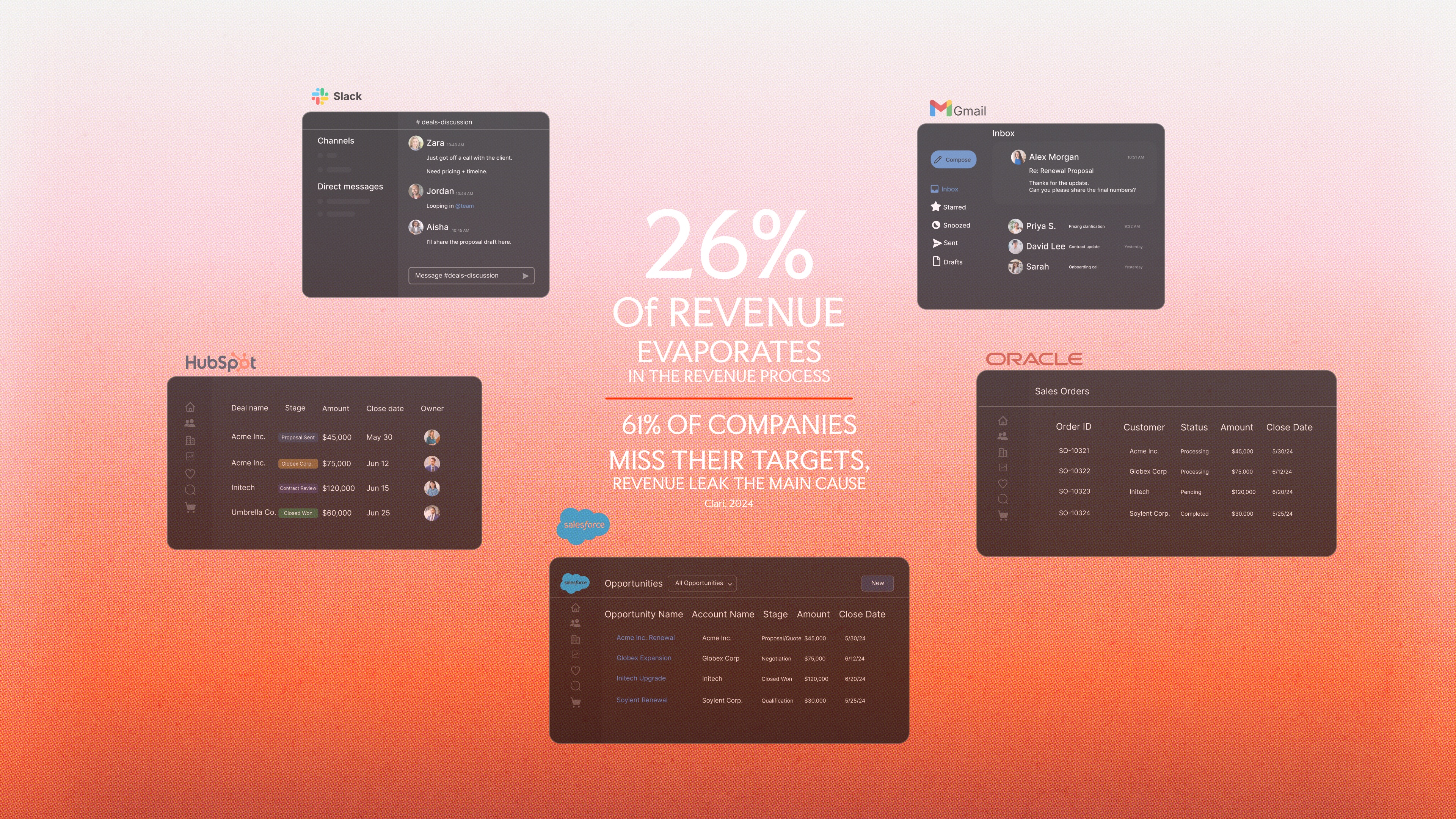
All this time, the CRM shows the deal at Commit. A CRM moves deals forward, stage by stage, and it has no reverse gear. Its AI can flag a deal that has gone quiet, but not the reasons outside the CRM: a redline sitting with Legal for a week, a questionnaire waiting for an analyst. So nothing pulls the deal back from Commit. The deal slips into next quarter, and the forecast is the last to know.
Nobody did anything wrong here. Every team answered and every tool worked. What was missing was coordination: who had to decide what, by when, with which information, and what happened if they didn’t. The process exists, in the sales playbook and the approval rules. Between teams and systems, nobody orchestrates it. The CRM stores the deal. It doesn’t coordinate what happens around it.
Bain estimates that sellers spend about a quarter of their time actually selling. Much of the rest goes to exactly this kind of chasing. An AI assistant can make each follow-up faster to write. It can’t make Legal answer, or tell Finance the deal exists.
That full cycle, from the first lead to the renewal, is what we call the revenue lifecycle. Every team in it now has some AI. Almost none of that AI works on the handoffs between them, which is where the quarter is decided.
What CRM AI and AI sales agents can and can’t do for revenue
CRM vendors saw the same gap, and their answer is AI inside the CRM: agents that research leads, update records, score deals and suggest next steps. They’re useful, and orchestration doesn’t replace them: it works with your CRM and its agents. But like assistants, they help people one at a time, on the record. The return the board is waiting for sits one level up, in how the whole operation runs across multiple teams and systems.
Their limit is scope. A CRM agent works on the record: the opportunity, the contacts, the activity log. It sees little of what happens around the deal, such as the approval waiting in an inbox, the clause in the contract tool or the credit check in the ERP. And it works for people with a CRM seat. Legal, Finance, engineering and IT security often don’t have one, so the agent never reaches them.
Every CRM now ships AI, and much of it has moved into Slack or Teams too. The question was never where the assistant sits. It’s who it can involve and what it can reach.
Adding more agents doesn’t solve that. Gartner’s analysts warn of agent sprawl, and that “more agents will not automatically mean more productivity.” One CRM provider’s own 2025 survey points the same way: 96% of sales leaders used AI regularly, and only 10% used it inside their CRM. And agents dropped on a process nobody orchestrates rarely survive the pilot. Gartner expects over 40% of agentic AI projects to be cancelled by the end of 2027, because of rising costs, unclear business value or inadequate risk controls.
→ Rule of thumb. One person, one tool: an AI assistant does the job. Many teams, many systems: you need orchestration.
Agentic orchestration: how to use AI in sales so it shows in revenue
Agentic orchestration coordinates everything a process involves, people, systems and AI agents, automatically and in the right order. Think of a conductor. The score already exists: it’s the process your teams follow. The orchestration makes sure every part comes in at the right moment, the same way every time. Inside that sequence, some tasks belong to people, like a decision or an approval. Some belong to systems, like updating a record or sending a document. And some go to AI agents, which gather context, check a request against policy or prepare a recommendation, with a person validating what they produce. Every step leaves a trace.
That is the difference from what most companies try first. Adding AI assistants to each team keeps the coordination exactly where it was. Redesigning everything before starting turns into an IT project with specs, an integrator and eighteen months before the first result.
You don’t need to start over. Your process already exists: the procedure your teams follow, the approval rules, Legal’s playbook. What it lacks is a conductor. Pick the revenue process that costs you the most, and let the orchestration run it as your teams already know it, between the people who decide, in the tools they already use. Then put AI agents on the steps where they save the most time.
Here’s the deal from earlier, orchestrated. When it reaches Commit, the four requests go out at once, each to the right person in Slack or Teams, with the deal context, the question and a deadline. An agent has already drafted the questionnaire answers it could find in past responses, so IT security only checks them and completes the rest. Answers flow back to the CRM record. When a deadline passes, the orchestration follows up, then escalates, and flags the close date as at risk. That’s the reverse gear the CRM never had: the forecast knows before the quarter does. Nobody has to chase. Handoffs that took days take hours, and the time reps spend chasing contributors drops by 50 to 70%.
Watch one deal run from lead to renewal: The Revenue Lifecycle video.
This is also what makes AI measurable. Where you find AI ROI in sales depends on the level you look at.
At the individual level, ROI is time. An AI assistant saves a rep forty minutes a day. That’s real, but those minutes dissolve into the rest of the day, and you can survey people about them without ever tracing them to revenue.
At the process level, ROI is the process’s own number. When a pricing exception is approved in two hours instead of two days, deals that would have slipped close inside the quarter. When Legal reviews two clauses instead of the whole contract, it comes back faster. Those numbers sit directly between the deal and the revenue: when they move, revenue moves, and you can show it on the topline within a quarter.
You don’t have to choose between the two. When AI works inside an orchestrated process, across the people, systems and agents it involves, the time it saves lands somewhere you can count it. That’s the real shift: from small individual gains, hard to see and harder to turn into revenue, to an operation that runs differently across teams and systems, with an impact the board reads in revenue. That change is unavoidable, and it can be smaller than most companies think.
Where AI ROI in sales shows up.
| Individual ROI | CRM ROI | Process ROI | |
|---|---|---|---|
| AI takes the form of | AI assistants and copilots | CRM AI and agents | Agents inside one orchestrated process |
| Works for | One person | The CRM's users | Every team, system and agent a deal crosses |
| Measured by | Minutes saved, mostly self-reported | Adoption, data completeness | The process's own KPIs, before and after |
| Shows up | In the rep's day | In the CRM dashboard | In revenue |
And because every step is traced, you see exactly where the process slows down, so you keep improving it. When a CFO or an auditor asks who approved a pricing exception, and on what basis, the answer takes one click.
Three places revenue moves, and why the forecast follows
Once AI works at the process level, and not only on one person at a time, its effect shows up in revenue, and you can measure it.
More time to sell: a bigger pipeline
When the orchestration does the chasing, reps get that time back, and they spend it where it pays: on customers and on new opportunities. It’s the hour per rep our former CCO was counting, except that it comes from work that disappears for every team involved at once, at the level of the whole operation. More selling time means more conversations, and a bigger pipeline.
Better qualification: a higher conversion rate
Many deals that die late were qualified by one person. They look solid in the CRM, then stall in scoping, because nobody asked Legal, Customer Success or Finance early enough whether the deal could be signed and delivered. When qualification runs as an orchestrated process across those teams, weak deals are set aside early, strong ones get the attention they need, and more of the pipeline converts.
Nothing missed: margin that holds
A discount approved in a thread nobody can find. A delivery date promised to the customer that delivery never saw. A clause signed outside the playbook. Clari’s research found that 26% of revenue evaporates in the revenue process, and that 61% of companies miss their target with leakage as the primary cause. When each team comes in at the moment its decision is needed, these problems surface before the signature, while there’s still time to fix them, and the margin you sold is the margin you keep.
In the end, that’s more revenue: sales cycles 10 to 20% shorter, the 3 to 5% of revenue that leaks in quote-to-cash (MGI Research) recovered or brought forward, and customer onboarding that reaches time to value 40 to 50% faster. These are process numbers, which is why a CFO can check them.
Three places revenue moves.
- More time to sellA bigger pipeline
- Better qualificationA higher conversion rate
- Nothing missedMargin that holds
And a forecast you can trust comes with it. One CRO we spoke with is held to plus or minus 10% by the board, while the field roll-up misses by 30 to 50%. Nobody lied about those deals. They spent their lives outside the CRM. When every deal moves forward on answers someone owns and has checked, and steps back when it should, the commit reflects reality.
How Ofelia Agentic takes AI beyond the CRM
Ofelia Agentic is the governed execution layer for the revenue lifecycle, inside Slack and Microsoft Teams. Your CRM stays the record. Ofelia orchestrates the work around it, with AI doing the preparation and people making the decisions. It works with whichever CRM you run, and nobody has to learn a new tool.
Ask. Anyone involved in a deal asks a question in Slack or Teams and gets one answer, drawn from your approved documentation and the knowledge you connect: where a deal is stuck and why, including the reasons no CRM can see, which terms apply, why a signed contract hasn’t been invoiced. Ofelia answers and guides the next step, in a private conversation.
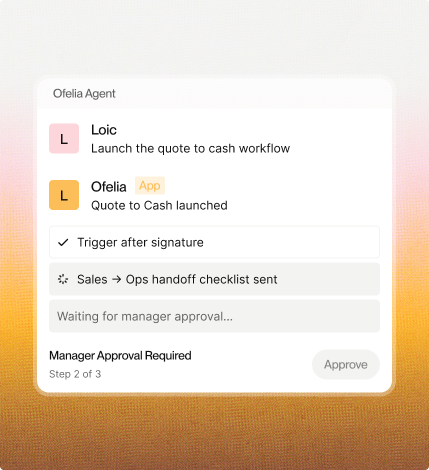
Build. Sales Ops or RevOps hands Ofelia the procedure they already have, or describes the process in plain words. Ofelia generates the workflow model: the steps, the approvals, the thresholds, who does what. The process owner edits it in a no-code editor, tests it in a sandbox and publishes it live in Slack or Teams. No developer and no IT ticket, while IT keeps role-based access, approved connections and a full audit trail.
Run. One message in Slack or Teams launches the process, and Ofelia runs it the same way every time. Each task reaches the person who has to act, including people who never open the CRM. Systems update along the way. Where it helps, an agent prepares part of a step, and a person validates every outcome before the process moves on. Ofelia follows up, escalates when a deadline passes and records every action.
Measure. Every process reports on itself, at two levels. For the CRO, the business numbers: revenue at risk, conversion, cycle time, margin held, and a forecast trust score that shows how much of the commit you can rely on. For the process owner, the process numbers: where deals wait, which steps cost the most, which exceptions keep coming back, so the process improves week after week. AI finally gets measured on the numbers your board already reads.
Underneath runs the process engine behind Bonita BPM, which has run enterprise processes for more than 15 years at more than 130 enterprise customers.
Deals are decided outside the CRM: in the handoffs, the approvals, the follow-through. That’s where your AI needs to work.
Schedule a personalized demo and see how Ofelia can transform your operations.