A deal desk, also called a sales desk, gets non-standard deals approved before signature. What it reviews, who takes part, where it stalls, how to run it.
Deal desk
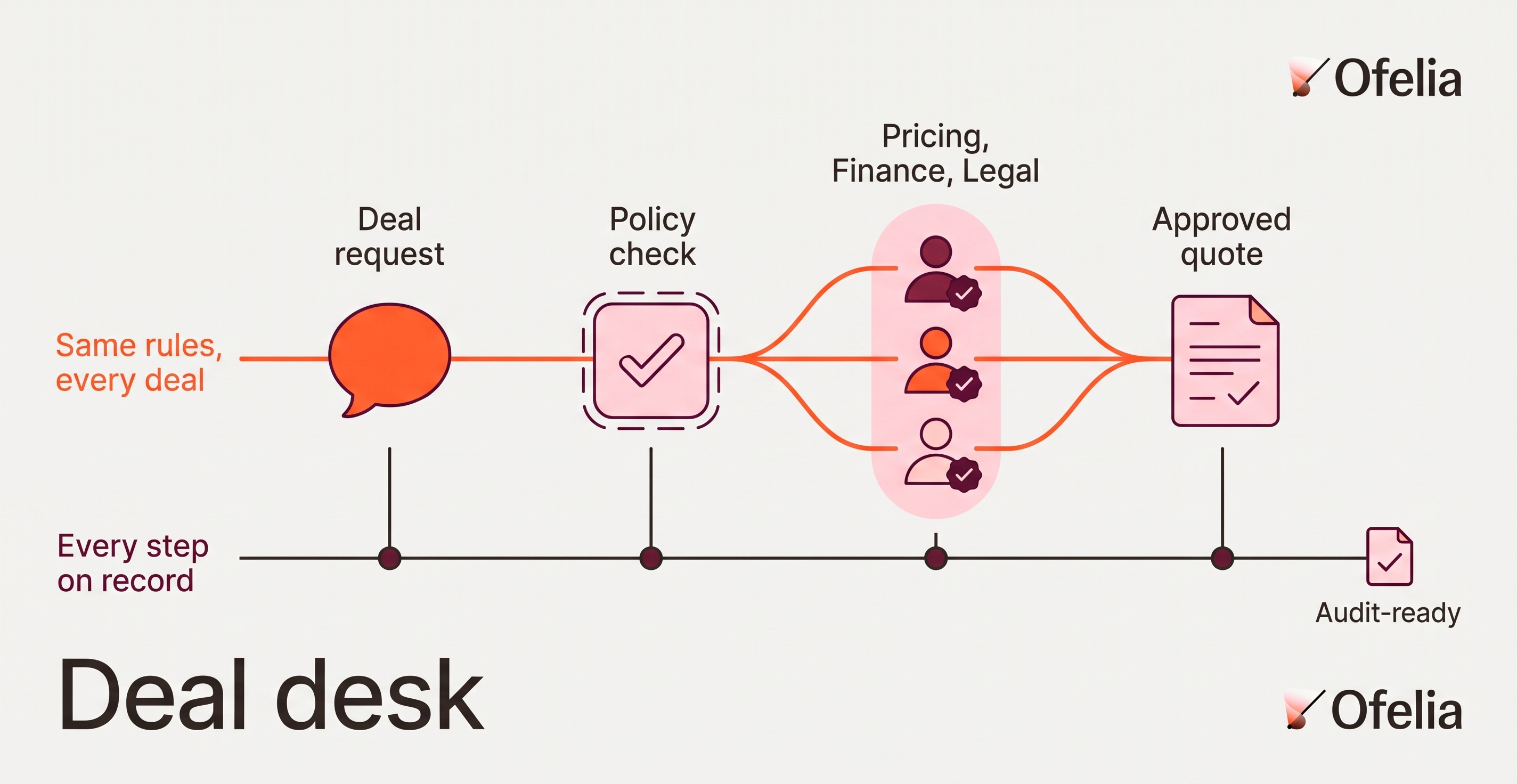
A deal desk, also called a sales desk, is the team, sometimes one person, that gets non-standard deals approved before signature: price and discount, payment terms, clauses, scope and delivery commitments. It runs a process that crosses Sales, Finance, Legal and, depending on the business, Delivery, Customer Success or production.
In most companies the deal desk is a process run by a team, not a tool and not a function. It sits inside quote-to-cash, at the quote and approvals stage: after the offer is scoped, before the contract is signed.
Why the deal desk matters now
The deals that need a bigger discount, a custom payment schedule or a clause Legal has not seen are often the largest deals of the quarter. They are also the slowest, because each exception waits on someone in another team. MGI Research estimates that at least 3 to 5% of a company’s revenue leaks through quote-to-cash, much of it between the quote and the contract, and between the contract and the cash.
Each reader sees a different side of it. The deal desk manager runs the process and answers for its speed. RevOps sees the deals sitting on another department’s desk. The CFO sees margin and payment terms decided under quarter-end pressure, sometimes in a chat thread. Where revenue leaks in quote-to-cash maps each of those leaks, from scoping to cash.
What a deal desk does
A deal desk applies the pricing and contract policy deal by deal, and decides what the policy does not cover. Which deals go through depends on thresholds: most companies route only non-standard deals, while some route every deal above a certain size.
It reviews price and discount, payment terms and credit, clauses, scope and delivery commitments, and contracts that involve several entities. Approvals are tiered by what is at stake. A common pattern for discounts: under 20%, the sales director decides; from 20 to 40%, the COO; above 40%, the CEO. In many revenue organisations the VP Sales approves above the rep’s limit and Finance is not in the loop at all, while in others Finance gates every term. Both models exist, and the deal desk adapts to the company, not the other way round.
Where the deal desk breaks in practice
The deal desk rarely breaks on a decision. It breaks on the path the request takes between the teams.
Take a three-year deal, call it Acme, where the rep needs a 30% discount and 90-day payment terms. The rep asks the sales director in Slack. The director asks Finance by email. Finance asks for the contract draft, which the rep has not shared yet. Legal gets a call the day before signature and finds a clause it cannot accept. Three weeks pass, and nobody can say who holds the deal. Pricing drifts too: three people approve the same discount three different ways, and none of the approvals reaches the invoice. A Director of Sales Administration at a software company describes the result: “I feel like I am harassing teams: is it done? is it done?”
The process exists in every company that has a deal desk. What slows it down is everything it has to cross: teams, tools, inboxes, calendars. Run as one orchestrated process, approval time drops by 40 to 60%, pricing compliance reaches 95% and above, and the load on Legal gets 30 to 40% lighter.
Deal desk vs CPQ, pricing committee, contract management and pipeline review
These four are often confused with the deal desk, and each does its own job well before its scope stops.
One test tells them apart. If the answer only needs Sales, it belongs to the pipeline review; if it needs Finance or Legal, it belongs to the deal desk.
How to run a deal desk well
Write the tiers down first, then make the orchestrated path the fastest one. A rep who follows it gets an answer in hours, and a rep who goes around it waits.
- One request carries everything: scope, price, terms, credit, contract draft.
- Approvals run in parallel, with a deadline for each approver.
- When an approver misses the deadline, the process asks, reminds, then escalates. Nothing is approved by default.
- Legal enters at the step where the clause appears, not the day before signature.
- Every decision goes on record once, so the approved terms travel to the invoice and to onboarding. That record is the deal’s audit trail.
- The person who approves is the one accountable, which is what human-in-the-loop means on a deal.
Then measure three things: days from request to decision, the share of deals within policy, and how many deals reach Legal with less than a week to go.
Callout · Three questions that tell a deal desk from a bottleneck
- Who holds the deal right now, and since when?
- Under which rule was the discount approved?
- Can Finance see the approved terms when the invoice goes out?
Learn more: see where quote-to-cash leaks between teams, from scoping to cash, and how operations and sales teams run their approvals with Ofelia.
Ofelia Agentic and the deal desk
Ofelia Agentic is the governed execution layer for the revenue lifecycle, inside Slack and Microsoft Teams. It runs the deal desk where reps, Finance and Legal already talk, works with your CRM and any system you use, and leaves every decision to a person.
Ofelia answers and guides first. The rep asks “What discount can I give Acme without an approval?” or “Who approves 90-day payment terms?”. Ofelia answers from your pricing policy and your connected systems, then guides the rep to the next step, with a button to submit the deal package.
A non-standard deal needs more than answers, so Ofelia runs the deal desk as a workflow: the same checks on every deal, each approver receiving their part with a deadline, every decision traced. The rep launches the Acme request from Slack. Ofelia checks it against the policy, lets the standard part through and routes the exceptions to the approver, Finance and Legal at the same time, each with a deadline. An agentic step brings Finance a recommendation on credit and payment terms, and Finance decides. When an approver misses the deadline, Ofelia asks, reminds, then escalates. The quote is generated on the approved terms, the CRM is updated, and the signature request goes out once every approval is in.
Watch one deal orchestrated from lead to renewal, in four minutes
The deal desk manager or RevOps gives Ofelia the pricing policy and the approval rules. Ofelia proposes the workflow, with its thresholds, approvers and parallel steps, and the owner adapts it in the no-code Workflow Designer, tests it and publishes it into Slack or Teams. The approver for each threshold is a setting, not code. IT keeps control of who can build and publish, of access and connections, and of the full audit trail. Everyone a deal needs can take part, CRM seat or not.
Run this way, the pricing exception cycle goes from hours to minutes, and 2 to 5% of margin is held on non-standard deals. Under the hood, Ofelia builds on Bonita BPM, which has run enterprise processes for more than 15 years at more than 130 enterprise customers. The right path is the fastest one.
Download the Revenue Lifecycle one-pager (PDF).
See Ofelia run your deal desk in a personalised session
Frequently asked questions
What does a deal desk do?
A deal desk gets non-standard deals approved before signature. It reviews discounts above policy, payment terms, clauses, scope and delivery commitments, routes each exception to the right approver and records every decision. It brings Sales, Finance and Legal to one answer, so a deal that leaves the standard path still closes fast and within policy.
When does a deal go to the deal desk?
A deal goes to the deal desk when it needs a decision Sales cannot make alone: a discount above the rep’s limit, payment terms Finance must check, a clause Legal must review, or a commitment Delivery must confirm. Standard deals skip it. The earlier the rep flags the exception, the faster the answer comes back.
Does every deal go through the deal desk?
No. In most companies only non-standard deals go through the deal desk, and the thresholds decide which ones: a discount tier, a payment term, a clause outside the playbook. Some companies route every deal above a certain size. Standard deals follow the policy and go straight to the quote.
Sources
MGI Research, Revenue Leakage, December 2025.