An audit trail is the record of who did what, when, on what basis and with what result in a process. Meaning, audit trail vs audit log, what AI changes.
Audit trail
An audit trail is the chronological record of every action and decision taken in a process: who did it, when, on what input, under which rule and with what result. It lets a company see how a process really runs, reconstruct how an outcome was reached and prove it to an auditor.
In our view, a useful audit trail follows the whole process from end to end, across the tools, and records every human decision, every system update and every AI agent outcome in one place. That is what makes governed AI orchestration something you can prove rather than declare.
What is an audit trail?
An audit trail answers five questions for every step of a process, and two more when an AI agent takes part. Accountants know the term from tracing a transaction back to its source document, and security teams know it from access records. The meaning is the same in both worlds: a record nobody edits afterwards, which lets someone who was not there follow what happened.
The same record has two readers. The business owner reads it to see whether the process is adopted, where requests wait and what it delivers, and to know who decided what and why. IT reads it to prove control, investigate an incident and answer the auditor. One trail serves both, as long as a person can read it without a query language.
Why audit trails matter now
For years, audit trails were a Finance and IT topic: who changed an invoice, who granted an access. AI agents widen the scope. When an agent drafts a quote, checks a contract clause or recommends a next step, the trail has one more question to answer: what did the agent propose, and who validated it? Without the record, human validation is a memory, not a proof.
The stakes are concrete. Gartner expects more than 40% of agentic AI projects to be cancelled by the end of 2027, with inadequate risk controls among the reasons. The EU AI Act asks high-risk systems for record-keeping and human oversight, and auditors already ask the same questions for everything else. The human-in-the-loop principle says a person validates; the audit trail is how you show that they did.
What the trail teaches you about the process
A trail is not there to police people. Read over a month, it shows how to run the operation better, because it records the process as it actually ran rather than as the procedure describes it.
- Adoption: how many requests take the orchestrated path, and how many still go around it by email or chat.
- Waiting: where requests sit, since when, and which approval slows the whole process down.
- Corrections: where people change what an agent proposed, which tells you where the agent needs better inputs or tighter rules.
- Results: cycle time, completion rate and what the process delivers at the end.
The same record gives IT what an incident or an audit needs, without a second system. It shows the process, not the people, and the time a team stops spending on chasing goes back to the work itself. Ofelia Workflow reads the trail this way, as a view on how the process runs.
Where audit trails break: the work between the tools
Each system keeps its own log. The CRM records stage changes, the ERP records invoices, the ticketing tool records tickets. The trail breaks between them, exactly where decisions are made: a discount approved in a chat thread, a record updated by an integration nobody watches, an AI output accepted with no name next to it.
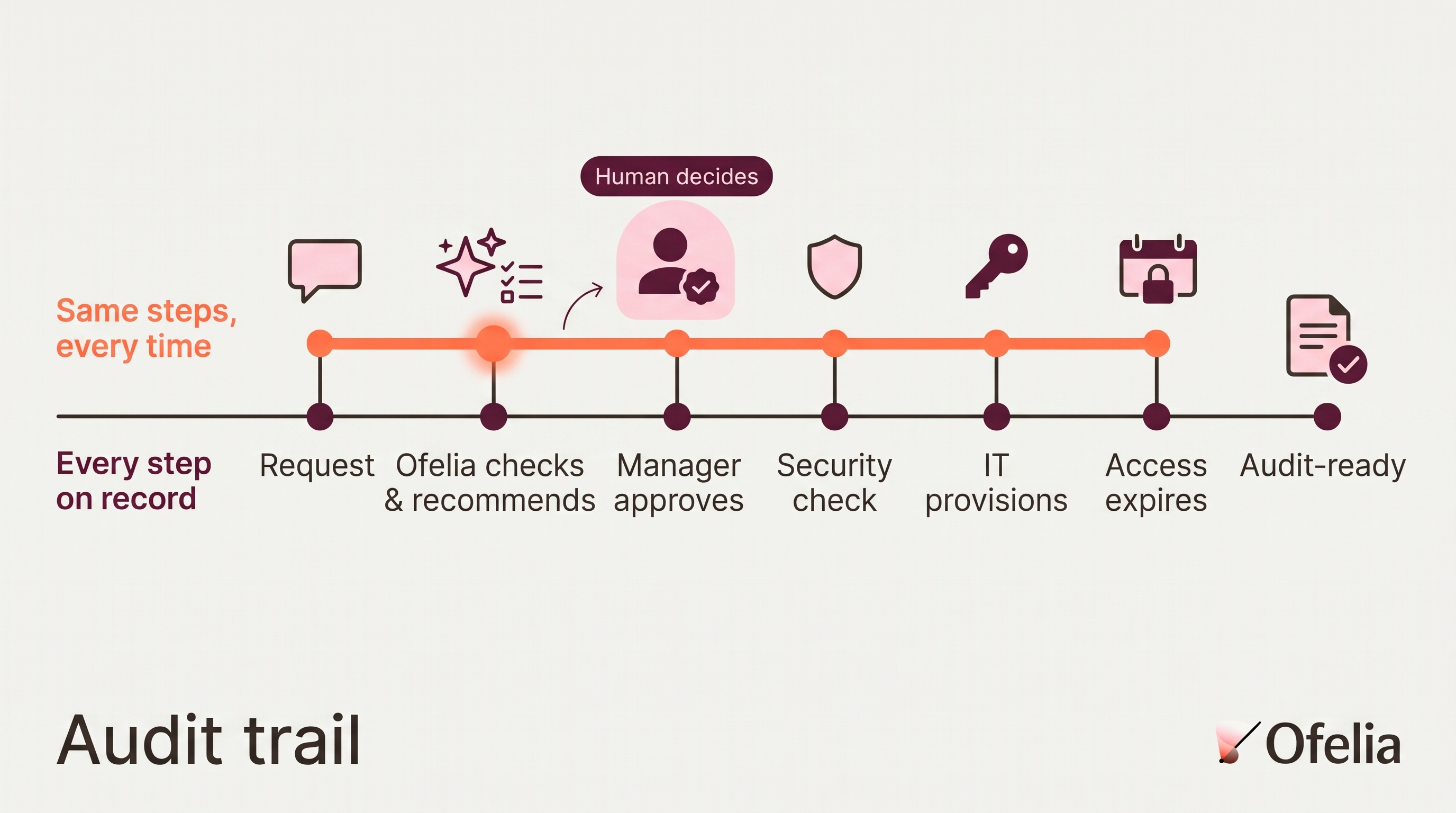
Take an ordinary request: Jira access for a contractor on Project X, for three months. The request goes out by email. The manager says yes in a chat. IT provisions the access, nobody schedules the expiry, and Security never learns that the tool holds sensitive data. At the next audit the permissions are still there, and nobody can say who approved them or until when. A screenshot of a conversation is not an audit trail.
Run as one orchestrated process, the same request looks different: provisioning 50 to 60% faster, orphaned permissions down by 70% or more, no contractor access without an expiry date, and the auditor’s question answered at once. Finance meets the same gap at month-end, when approvals scattered across threads have to be rebuilt for the close, one of the leaks of quote-to-cash.
Audit trail vs audit log, traceability and monitoring
The terms are often used interchangeably, and they should not be. An audit log is a technical record a system keeps about itself: logins, errors, configuration changes. An audit trail is a business record that follows one process or one case from start to finish, across systems, in a form a person can read.
Traceability is the property the trail gives you: the ability to follow a decision back to its inputs and its author. Monitoring is the live view of a process while it runs. Compliance is the outcome, provable rather than declared. Logs feed the trail, and the trail is what an auditor reads.
How to build an audit trail that holds
An audit trail holds when the act of deciding produces it, not when someone writes it up afterwards.
- Start from the decisions that carry risk: approvals above a threshold, exceptions to policy, anything an auditor could ask about.
- Put each one on an orchestrated path, where asking, approving and escalating produce the record by themselves. Business process management has worked this way for decades inside dedicated applications.
- Record the basis, not only the outcome: the rule or the document the decision relied on.
- For every agentic step, record the proposal and the verdict. A person validates every agentic result.
- When an approver misses a deadline, the process asks, reminds, then escalates. Nothing is approved by default.
- Keep the trail readable by the business owner, while IT keeps control of who builds the process, of access and of connections.
Above all, make the orchestrated path the fastest one. If approving in the process takes longer than approving in a chat, people approve in the chat, and the trail is empty where it matters most.
Callout · Three signs your audit trail has gaps
- A discount, a contract exception or a payment term was approved in a chat thread, with no record of who said yes.
- You can see that a request changed status, but not what was checked before it did.
- An AI tool drafted or decided something, and nobody can show who validated it.
Learn more: discover Ofelia Agentic, the governed execution layer in Slack and Teams, and see how human-in-the-loop works on a real process.
Ofelia Agentic and the audit trail
Ofelia Agentic is the governed agentic execution layer for enterprise operations, inside Slack and Microsoft Teams. It produces the audit trail as a by-product of running the process, works with any system you use, and leaves every decision to a person.
Ofelia answers and guides first. An IT manager asks “Who approved the contractor’s Jira access, and when does it expire?” or “What is our access policy for contractors?”. Ofelia answers from your documentation and your connected systems, then guides the person to the next step, with a button to submit or check a request.
An access request needs more than an answer, so Ofelia runs it as a workflow: the same steps on every request, each owner receiving theirs with a deadline, every step traced. The contractor’s request is launched from Slack. The manager gets the approval with a deadline, Security is notified because the tool is sensitive, and IT gets the provisioning task once the access is approved. The expiry is scheduled, and the access is removed on the end date. An agentic step checks the request against the policy and recommends; a person validates. When an approver misses the deadline, Ofelia asks, reminds, then escalates. The trail shows who asked, who approved, when, under which rule, what the agent proposed and what the person decided, and the business owner reads the same record to see where requests wait and what the process delivers.
The process owner gives Ofelia the access policy or describes the process in plain language. Ofelia proposes the workflow, and the owner adapts it in the no-code Workflow Designer, tests it and publishes it into Slack or Teams. A published change applies from the next request. IT keeps control of who can build and publish, of access and connections, and of the full audit trail, as the IT Hub shows.
Under the hood, Ofelia builds on Bonita BPM, which has run enterprise processes for more than 15 years at more than 130 enterprise customers, with full audit trails and role-based access built in. The right path is the fastest one, and it is the one on record.
Download the Ofelia Agentic one-pager (PDF).
See Ofelia keep your actual workflows on record in a personalised session
Frequently asked questions
What is an audit trail?
An audit trail is the chronological record of every action and decision in a process: who acted, when, on what input, under which rule and with what result. It lets a business owner see how the process really runs, and lets IT or an auditor reconstruct and prove how an outcome was reached.
Audit trail vs audit log: what is the difference?
An audit log is a technical record a system keeps about itself, such as logins, errors and configuration changes. An audit trail follows one business process from start to finish, across systems, in a form a person can read. Logs feed the trail, and the trail is what the business owner and the auditor read.
What should an AI agent audit trail include?
An AI agent audit trail records everything a classic trail records, plus two lines for each agentic step: what the agent proposed, with the inputs it used, and who accepted, changed or refused that proposal, and when. Without the proposal you cannot explain the outcome; without the verdict you cannot prove oversight.
Sources
Gartner, press release June 2025, over 40% of agentic AI projects will be cancelled by end of 2027. European Union, AI Act, Article 12 (record-keeping) and Article 14 (human oversight). NIST, AI Risk Management Framework 1.0.